The Software Development Life Cycle
The software development life cycle (SDLC) is a process definition that specifies how the industry chooses to develop software projects. It is standardized in ISO/IEC 12207 and wants to define all tasks required in order to implementing (and maintaining) a software project.
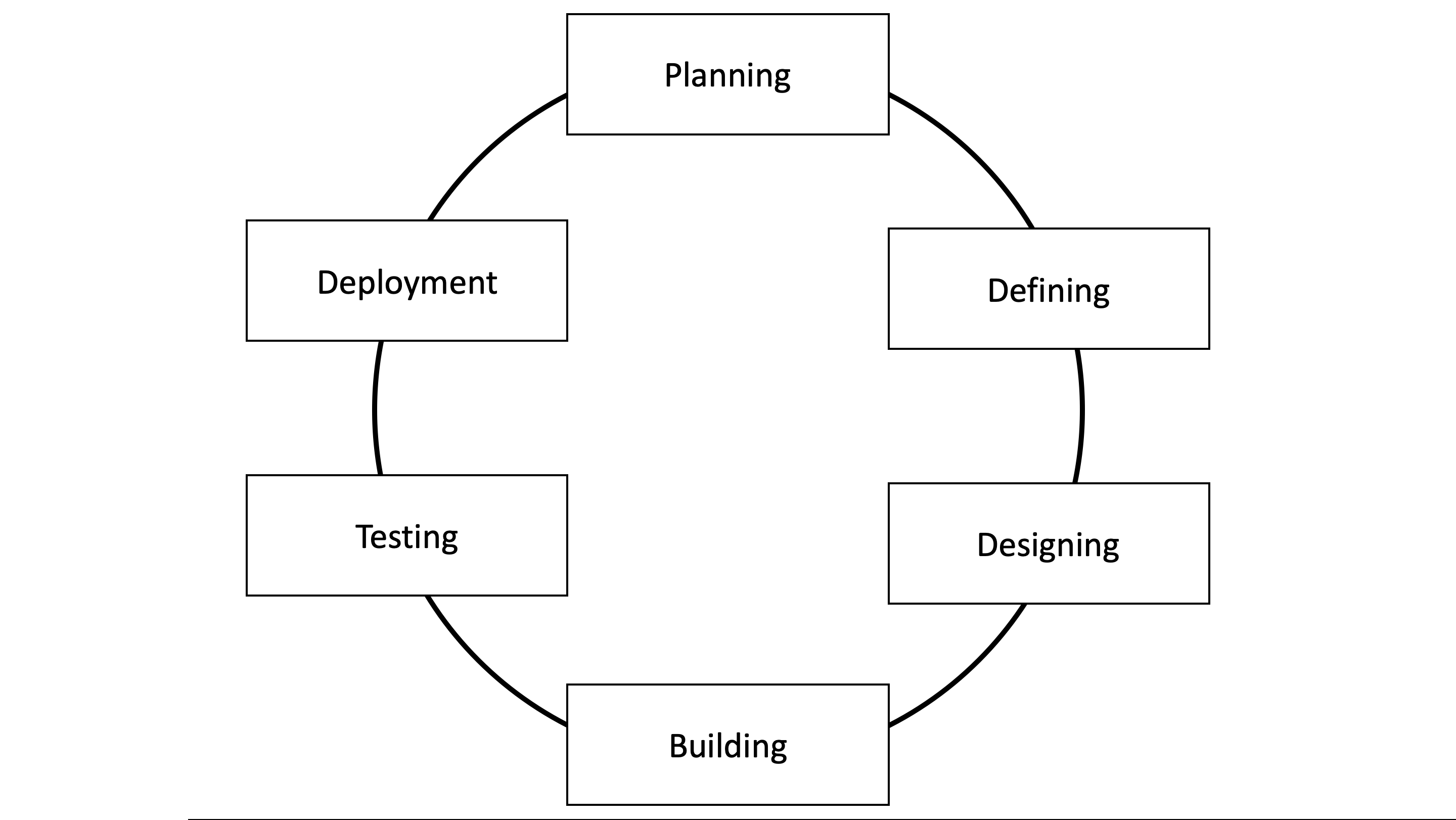
Software Development Lifecycle (or SDLC).
Step 1 - Requirements Analysis
In this crucial step the requirements of a software project are defined. Sometimes also referred to as Requirements Engineering this step is done by the development team in conjunction with the customer, the sales & marketing team and any other outside stakeholders.
This step also aims at specifying the risk factors that may be present in this project.
An example for a requirement would be the fact that a user wants to be able to edit a message in Webex Teams.
Step 2 - Requirements Definition
After analysing all requirements and risks the next step is to define them. The outcome of this step is a Software Requirement Specification (or SRS) that specifies all requirements and risks that can be seen in this project.
One common tool in this definition are Use stories (you will hear more about them in the next chapter). An example of such a use story, based on above requirement, would be
As a Webex Teams user I want to be able to change messages that have been sent so that I don’t have to always correct my messages with another message.
Step 3 - Design the System
Based on the SRS we then design the system itself. The Design Document Specification (or DDS) captures how the system is designed. This can (and should) include
- A overview of all modules that are impacted by the changes
- How data flows between these modules
- Which new modules are added to the system
In our example impacted modules might be the API(We need to provide API functionality to change a message), the database layout (instead of overwriting the old message we might want to save a new version).
Step 4 - Develop the Code
Based on the DDS the developers next are able to implement(read: code) the product. The choice of programming language(s) used is usually dependent on the programming languages already used, the product being developed (developing a web application in assembler is rather non-sensical) and the teams knowledge (retraining 5 python programmers to develop in Java won’t do a lot of good).
In big teams a Coding Convention is often introduced to make sure that all the code “looks” the same. Part of such a coding convention could be for example the way to name variables (always use lowerCamelCase or slash_seperated) or how to indent code (tabs vs spaces).
In our example the back-end services might be implemented in python and thus the team uses this language to make the changes.
Step 5 - Testing
Testing used to be a separate step after the implementation. Today most software is continuously tested during the implementation phase.
In our example this would mean writing unit tests, integration tests and user tests. You will learn more about these in the chapters to follow.
Step 6 - Deployment
In this stage the product is rolled out into the market. This might include first rolling it out to a limited subset of users to check if the functionality works or just releasing the software.
Deployment cycles have become much much shorter in the past two decades. Where it used to be acceptable to deploy new code once a quarter or once every half a year todays web software gets continuously updated, often every minute.
After a successful deployment we jump into the next planning phase.
Based on this cycle many flavors have been developed. Examples include
- Waterfall Model
- Iterative Model
- Spiral Model
- V-Model
- Big Bang Model
- Agile
and many many more.
What is the right development model for me?
Even though agile seems to be on vogue right now there is no generally right or wrong here. So lets have a look at different development models and discuss their pros and cons.
Waterfall Model
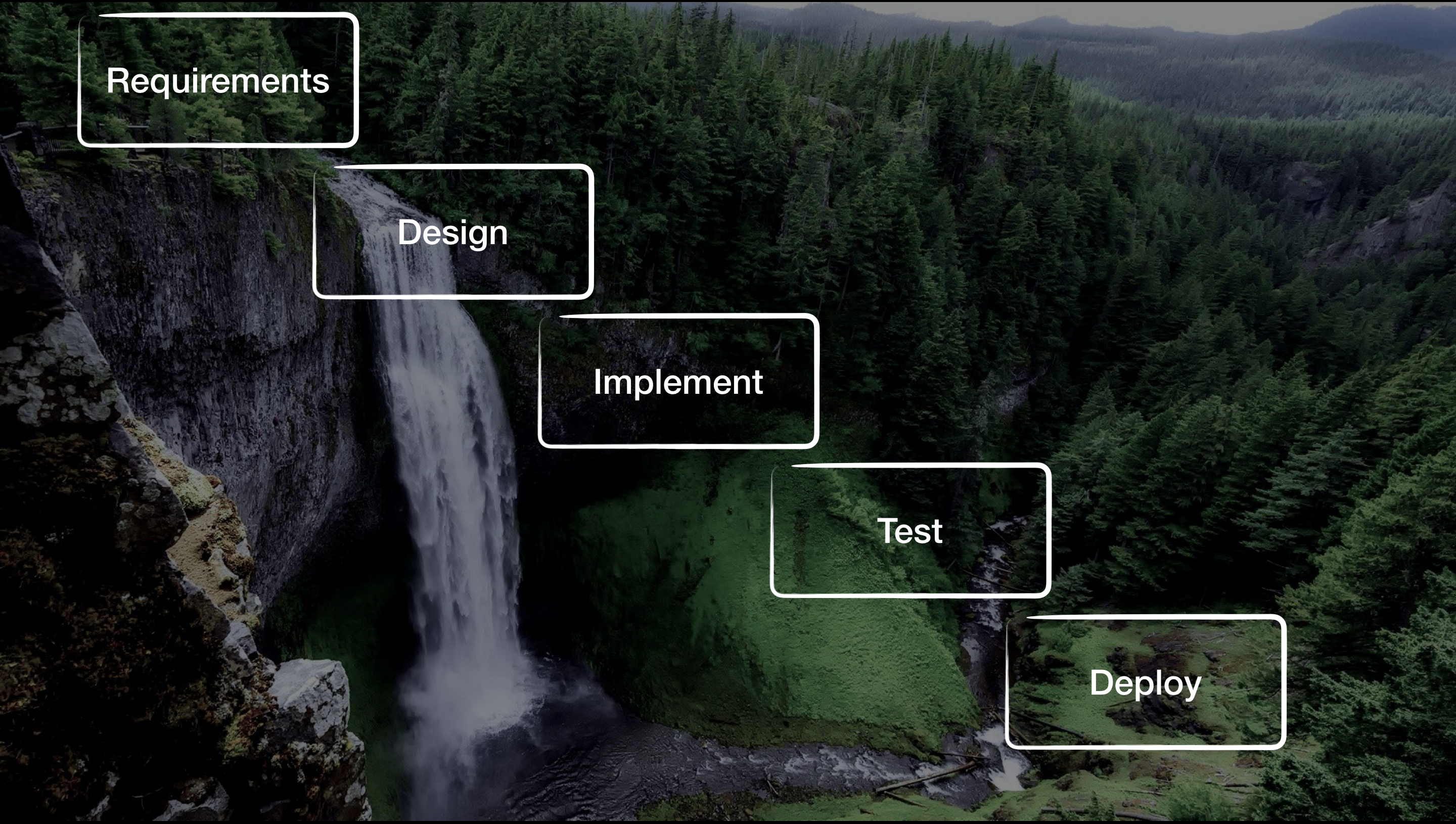
The waterfall model was amongst the first development models used. In this model every step leads to the next one and, once finished, steps are not revisited until the next cycle. Due to this restriction waterfall models are best suited for projects with
- well documented, understood and fixed requirements
- well established technology
- short project lifetime
Advantages of this model are
- Simplicity
- Low management overhead due to clear deadlines, clear stages and simple milestones
Disadvantages of this model are
- No working product until long into the cycle. This leads to a high risk of failure due to inadequately understood requirements or factors.
- No agility to react to changing requirements
Iterative Model
The iterative model aims to be more resilient to changes in the requirements. Instead of implementing all features in one big cycle the team starts with implementing a small subset of requirements. In each iteration a new set of requirements is implemented until a fully functional product is released.
Special to this model is that, initially, only major requirements are needed. After each iteration the need for new requirements is assessed and, if need be, new requirements and design considerations are added.
The SRS and DDS are thus seen as a “living” document that can be added to instead of a set collection of requirements.
The iterative model is well suited for projects where
- Major requirements are defined but details may be added later
- A product needs to be shipped that can then be enhanced over time (Time-to-Market Constraints)
- High-risk requirements exists that may or may not change in the future
Advantages of this model are
- Early working prototypes can serve as frequent deliverables. This leads to easier incorporation of customer feedback since working versions can be tested.
- Easy milestones and progress definition
- Testing and debugging is easier on small, incremental, iterations
- Smaller cost of change due to more flexible requirements definition
Disadvantages are
- Issues with overall system architecture may arise due to design-critical requirements not being gathered at the beginning
- Complex management leading to a unsuitability for small projects
- No clear end of project
Spiral Model
The spiral model is a logical combination of the waterfall and iterative model. It focuses on risk and leverages the incremental nature of the iterative model to enhance the product as well as mitigating the risk.
Each phase of the software development process (one loop in the spiral) goes through the same four steps
- Objectives determination Gathering of requirements and customer feedback to define objectives for the next phase. Often, alternative solutions are assessed in this phase.
- Risk Identification and Design A design (prototype) of the solution is created and associated risks are assessed.
- Development A working model of the software is developed. In the baseline spiral (the first phase of the development) a proof-of-concept is developed that is then send to the customer for feedback. In subsequent spirals a new build is send to the customer for feedback.
- Review The progress is reviewed, risk assessed and the next phase is planned.
Phases can have different lengths and the exact number of phases needed to complete the project is unknown.
The spiral model is best suited for projects where
- run-time of the project is long
- the requirements are unclear and/or complex
- the project has a high risk (either from a technical or financial perspective)
- a new product should be introduced in phases to constantly gather and incorporate customer feedback
Advantages of this model are
- Changing requirements can be accomodated
- Due to the ability to produce a prototype in every phase risk can be addressed more easily and users can provide feedback in every phase of the development
Disadvantages of this model are
- Complex management leading to a large overhead. This overhead is usually too large for small to medium size projects or projects with low associated risk
- Finalization of the project is unknown
- No clear timeline for milestones and/or deadlines
Big Bang Model
The Big bang model is a model that imposes no process onto the development team. Requirements, implementation and testing are done “on the fly” and at the discretion of the developers.
The big bang model is best suited for projects with
- Very small teams (one to two developers)
- Unclear requirements as well as unclear deadlines
Advantages of this model are
- No planning required
- Low overhead
- High flexibility for the developers
Disadvantages of this model are
- High risk and uncertainty of completion. The finishing of the project depends on the developers actually being able to deliver.
- No planning or design may result in expensive redesigns/rewrites or messy overall architectures
Agile Model
The agile model is a iterative and incremental development model where a product is split into small incremental builds. Every cycle (or iteration) involves the agile team to work on aspects like
- Planning
- Requirements
- Design
- Development
- Testing (Unit, Scenario and Acceptance)
Holy to the agile approach is the aspect of having a shippable, improved product after each cycle.
The agile manifesto defines four major beliefs
- Individuals and Interactions over process and tools states to focus on self-organization and communication between the parts of the team are important
- Working Software over comprehensive documentation instead of showing a document what the software will be able to do, show a working software that can do this. Agile defines working software as the best means of communication with the customer.
- Customer collaboration over contract negotiation instead of negotiating a contract at the beginning collaborate with the customer to build a satisfactory product
- Responding to change over following a plan instead of following a plan set before respond to change by adapting
The main difference between agile and the other models presented so far is that agile aims to be a adaptive approach compared to the predictive nature of the other models. Where predictive models rely on the analysis and planning phase to correctly asses the needs of a project agile accepts that most projects change and thus focuses on allowing the development team to adapt to these changes.
Frequent testing and constant interaction with the customer minimize the risk of major obstacles in the future.